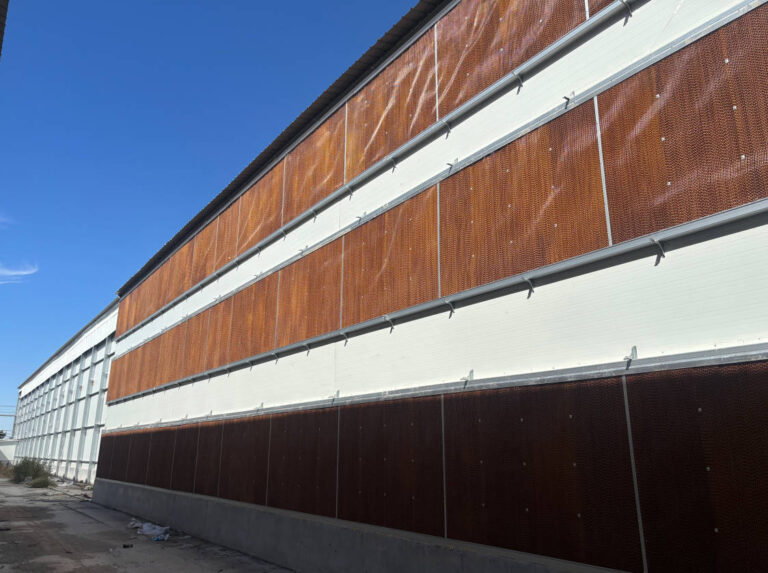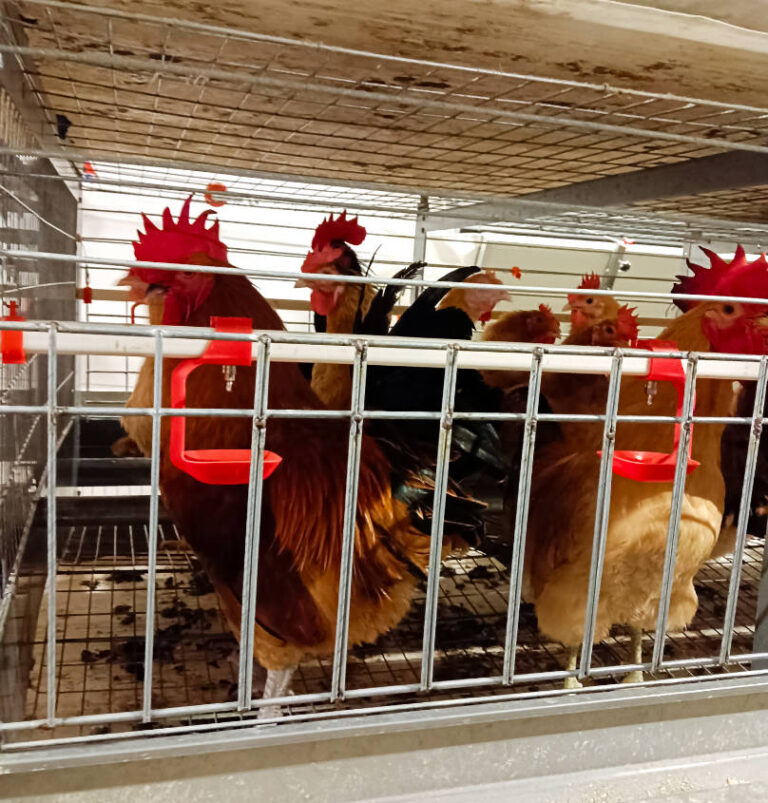

A poultry house ventilation system should replace stale air, remove heat and moisture, and deliver fresh air evenly at bird level. For a large layer farm, the design must connect exhaust fans, air inlets, cooling pads, sensors and controls. Fan count alone is not a ventilation plan.
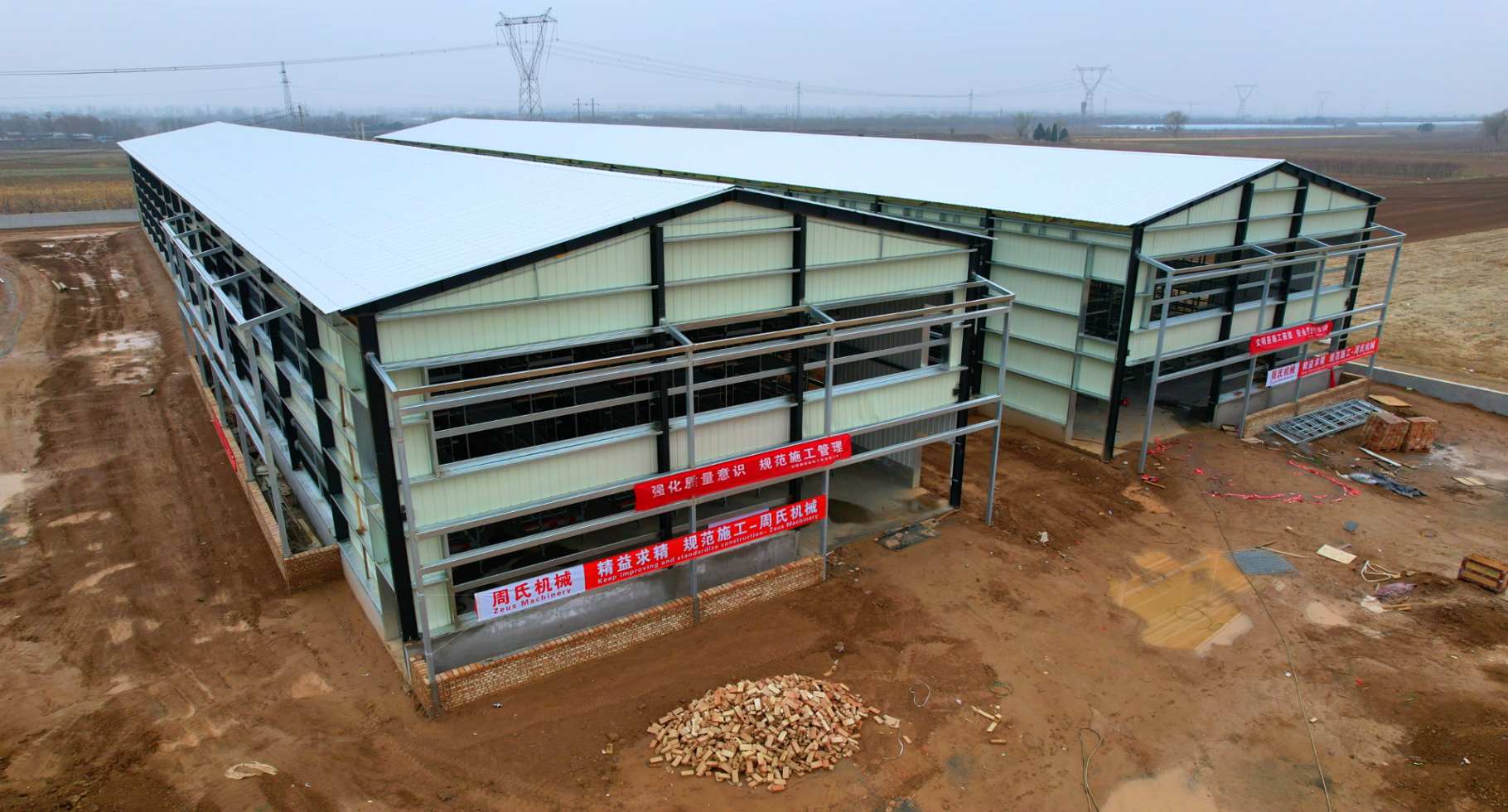
What Should a Poultry House Ventilation System Achieve?
Walk into a layer house on a difficult summer afternoon and the weak points appear quickly. Hens crowd a cooler section. Birds near one end pant while the controller shows an acceptable average temperature. Dust sits in a still corner. The last rows receive less air than the first.
Those are distribution problems, not just temperature problems.
A working poultry ventilation system has four jobs:
- supply oxygen and remove carbon dioxide, ammonia and dust;
- carry excess heat and moisture out of the building;
- distribute incoming air without leaving stagnant zones around equipment rows;
- change operating mode as outdoor conditions and bird heat load change.
The University of Georgia explains that negative-pressure fans, correctly adjusted inlets and ceiling-level air mixing work together. If inlet air arrives too slowly, it can fall before mixing, leaving cold or wet areas rather than ventilating the house evenly .
That is why we start a ZEUSYANG ventilation proposal with the house and flock data. Equipment selection comes later.
What Data Is Needed Before Designing Poultry House Ventilation?
Record the Poultry House Dimensions and Layer Capacity
Begin with the internal length, width and clear height. Mark columns, beams, doors, service passages and the occupied area. Then add the planned number of layers, their age or body weight, and the housing arrangement.
The same flock capacity can produce two very different airflow problems. A wider house may need more attention to inlet distribution. A long house may meet the calculated total airflow while still losing velocity near the exhaust end. Dense equipment rows add resistance and can trap warm air between birds.
Do not send a supplier only the number of hens. A usable drawing should show:
- house dimensions and orientation;
- bird capacity and housing layout;
- row spacing and maintenance passages;
- manure, feeding and egg-collection equipment that may cross the air path;
- the available fan wall and cooling-pad area.
Define Local Climate and Seasonal Conditions
Design around the site, not an annual-average temperature. The engineer needs summer dry-bulb temperature, relative humidity, winter lows, prevailing wind, elevation and power reliability.
Humidity changes the cooling strategy. A commercial-layer heat-stress guide notes that evaporative cooling works best in lower-humidity conditions; when humidity is already high, adding more moisture can increase heat stress, so air movement becomes more important .
This matters when choosing an evaporative cooling pad. A large pad is not automatically a better pad. It has to match the climate, water supply, fan duty and available inlet area.
Account for Heat, Moisture and Air-Quality Loads
Birds are only one source of load. Manure storage, leaking drinkers, motors, lighting and solar heat through the roof all affect the indoor climate. Manure can also obstruct air movement when it accumulates under housing equipment. A commercial-layer heat-stress guide recommends checking manure and airflow together before hot weather because decomposing manure contributes heat and can restrict air movement.
For this reason, the ventilation drawing should be reviewed alongside the drinking and manure-removal plans. Fixing a water leak may remove more moisture than adding another fan stage.
How Do You Calculate Poultry House Ventilation Requirements?
Calculate each operating mode separately. A large layer house normally needs a low-airflow mode for air quality, an intermediate mode for mild weather, and a high-airflow mode for hot conditions. The final values must follow the bird strain guide, age, climate and local engineering requirements.
Minimum Ventilation for a Large Layer House
Minimum ventilation runs when the house does not need cooling. Its job is to remove moisture and gases while retaining useful heat. It should continue whenever birds occupy the house, including cold weather.
Short, timed fan cycles are common, but timing cannot be copied blindly from another farm. Check relative humidity, ammonia, condensation and bird distribution. If the house becomes damp between cycles, either the airflow, run time or air mixing needs correction.
Inlets matter here. They must open far enough to create a stable jet toward the ceiling but not so far that incoming cold air loses speed and drops onto the birds. The required opening changes as more fans start.
Transitional Ventilation
As indoor temperature rises, the controller adds fan capacity. Transitional ventilation supplies more air without yet running the house as a full tunnel.
This is where poorly staged systems often become unstable. Fans start, static pressure changes, but inlet area does not follow. One section receives a hard draft while another remains warm. The control sequence therefore needs matched fan stages and inlet positions, not temperature setpoints alone.
When to Use a Tunnel Ventilation System
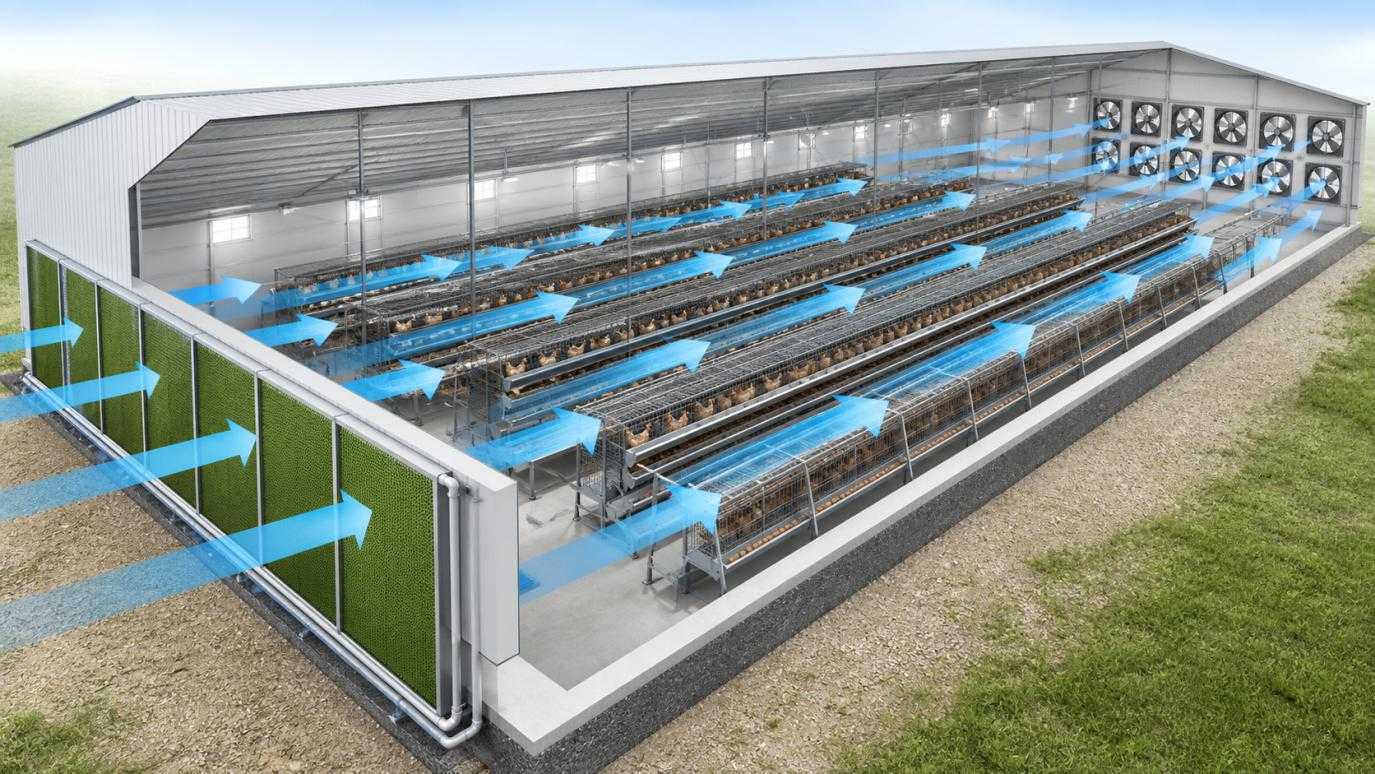
Tunnel ventilation is the hot-weather mode. Exhaust fans at one end pull air along the length of the building, creating useful air speed around the hens. Cooling pads may be added at the opposite end when climate conditions suit evaporative cooling.
The design airflow can be expressed as:
Required airflow = target cross-sectional air velocity × effective house cross-sectional area
This is only the starting point. Equipment, pad resistance, shutters, wind and air leakage affect the pressure against which each fan operates. The University of Georgia warns that designers can underestimate real tunnel-house static pressure, which reduces both fan output and expected air speed.
Use tested fan-performance data at the expected operating pressure. Do not divide required airflow by a free-air catalogue rating and stop there.
Which Poultry House Ventilation Equipment Is Required?
Match Poultry Exhaust Fans with Air Inlets
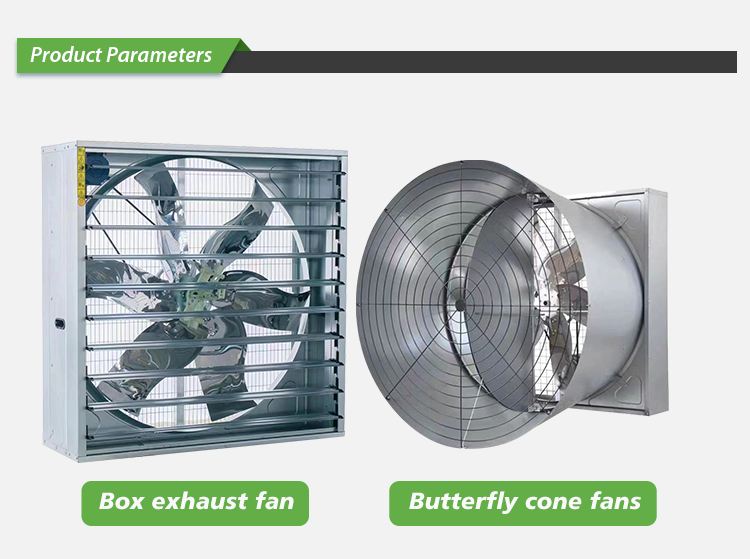
A poultry exhaust fan creates the pressure difference. The air inlets decide where replacement air enters and how it travels.
ZEUSYANG lists a push-pull fan with a nominal air-volume figure of 39,800 m³/h, a 1.1 kW motor option, stainless-steel blades and a hot-dip-galvanized frame. Treat that published airflow as a product reference, not as installed performance under every condition. For design, confirm the fan curve or test point, expected static pressure, shutter loss and safety margin.
A practical mistake looks like this: a planner calculates a peak requirement, divides it by 39,800 m³/h and orders the rounded number of fans. After installation, undersized inlets and dirty pads raise resistance. Each fan moves less air than assumed. The arithmetic was tidy; the house is still hot.
Match an Evaporative Cooling Pad with Exhaust Capacity
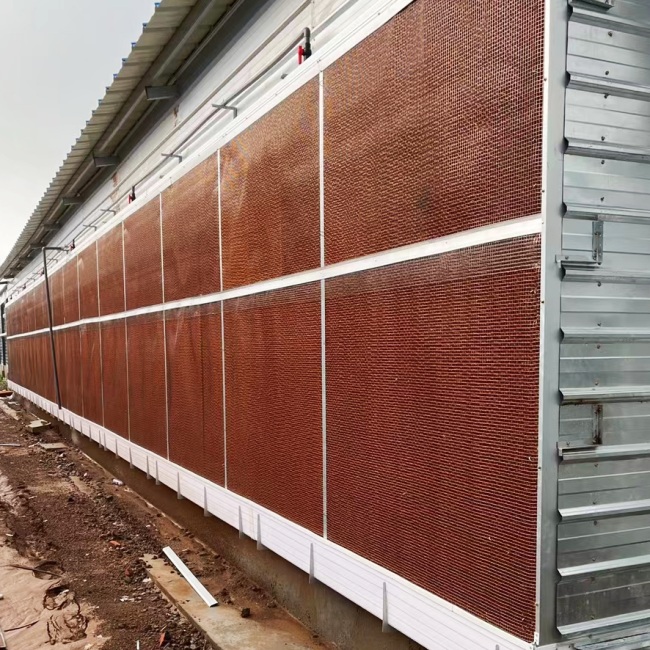
The cooling-pad face area must allow the required air to pass without excessive resistance. The pump and distribution pipe should wet the surface evenly, and the return system must handle the water flow.
ZEUSYANG offers 7090 and 6090 kraft-paper cooling-pad models for livestock and other facilities. Model choice is only one part of the decision. Water quality, pad depth, face velocity, maintenance access and the site’s humidity all affect operation.
Dry or clogged sections can create uneven resistance across the cooling-pad surface, causing air to bypass properly wetted areas. Commercial poultry management guidance also shows that evaporative cooling adds moisture and becomes less effective as ambient relative humidity rises. For this reason, cooling-pad operation should respond to both temperature and humidity, while fan capacity, pad area and water distribution should be checked as one system.
Connect Sensors, Controllers and the Electrical Cabinet
A poultry climate control system should stage fans and inlets, operate cooling pumps, monitor temperature and humidity, and issue alarms. Sensor position matters. One sensor in a convenient walkway cannot represent conditions inside every occupied row.
Place and verify sensors where they reflect bird conditions. Protect the system with an emergency power plan and high-temperature alarm. A commercial-layer heat-stress guide specifically recommends checking thermostat accuracy, static-pressure settings and auxiliary power before the hot season.
Manual override is still useful. It lets staff respond safely during commissioning or a sensor fault, provided the electrical design prevents conflicting commands.
How Should Airflow Be Arranged Inside a Large Layer House?
Prevent Dead Zones Around Equipment Rows
Air follows the route with least resistance. Columns, equipment banks, cross conveyors and partially blocked passages can redirect it. A centre-aisle measurement may look good while air inside the occupied zone moves slowly.
Before manufacture, overlay the ventilation path on the equipment layout. Check whether fresh air can reach every row and tier, whether service doors create leakage near the fans, and whether manure conveyors block low-level movement. For a built house, smoke testing, ribbons or handheld air-speed measurements help reveal the actual route.
Bird behaviour is another check. Uneven distribution, local panting or birds avoiding one section can reveal a problem that an average controller reading hides.
Keep Airflow Consistent from Inlet to Exhaust
House tightness supports predictable negative-pressure ventilation. Unplanned leakage near the fan end steals air from the intended inlets, so the remote end receives less fresh air.
During commissioning, test several operating stages rather than only maximum output. Record static pressure, inlet opening, fan status, temperature differences and air speed at repeatable points. A system that works with every fan running may still mix air poorly during minimum ventilation.
How Can Ventilation Control Heat, Humidity and Ammonia?
Ventilation removes moisture and gases, but it cannot correct every source problem by itself.
Start with the drinking system. Repair leaks and verify pressure before increasing winter ventilation. Review manure-removal frequency and check whether stored manure obstructs air. Then adjust fan timing and inlet mixing based on measured conditions.
UGA recommends maintaining relative humidity around 50–70% during brooding to limit ammonia and dust. That reference is useful for understanding the relationship, but a commercial layer farm should follow its layer strain guide and site-specific operating targets rather than copying a brooding value without review.
During heat stress, temperature and humidity must be read together. A commercial-layer heat-stress guide reports that caged hens can experience higher temperatures inside the occupied cage area than a walkway thermometer indicates. Air-speed checks therefore belong at bird level, not just beside the controller.
Planning Ventilation for a 50,000-Layer Farm
Consider a proposed house for 50,000 laying hens. The buyer sends only capacity and asks, “How many fans do I need?” There is no defensible answer yet.
First, identify the breed and age. A commercial-layer heat-stress guide’s published ventilation table for adult commercial layers gives different airflow ranges by ambient temperature and strain. Multiplying the relevant rate per 1,000 birds by 50 gives a design reference for this flock, but it still needs to be checked against the required tunnel air speed and house geometry.
Next, draw the system:
- Mark the occupied cross-section and obstructions.
- Select the seasonal operating modes and design conditions.
- Calculate the airflow required for each mode.
- Select fans from performance data at expected static pressure.
- Size inlets and cooling-pad area for that airflow.
- Map sensors and the controller sequence.
- Check power capacity, backup power and alarm response.
- Commission the completed house at several fan stages.
The result may use the same fan model as another 50,000-bird project but a different quantity, inlet arrangement or pad area. Climate and building geometry make that normal.
This is a planning example, not a claim about a named ZEUSYANG customer. The company’s published one-million-layer project confirms that its project scope can integrate climate monitoring with feeding, drinking, egg collection and manure removal, but it does not publish enough ventilation parameters to reuse as a calculation case here.
Installation, Commissioning and Maintenance
Checks Before the Flock Enters the House
Run every fan and confirm rotation, shutter opening, motor current and abnormal vibration. Inspect belts and guards. Check that inlets respond to the controller and return to the intended position at each stage.
Wet the entire cooling-pad surface and look for dry bands, overflow or blocked return lines. Test temperature, humidity and pressure sensors against a reference instrument. Trigger the high-temperature alarm and simulate loss of main power.
Finally, close the doors and test the building as it will operate. An open service door can make a commissioning result meaningless.
Routine Maintenance During Production
Dust changes fan performance gradually, so the problem is easy to miss. Clean blades, shutters, guards and pads on a planned schedule. Check belt tension, bearings, inlet linkages, water filters and sensor calibration. Keep records of static pressure and temperature differences; a slow change can signal blockage or leakage before birds show stress.
Seasonal checks matter too. Test maximum ventilation before hot weather arrives. Review minimum ventilation before the cold season, when moisture removal becomes harder and unnecessary heat loss becomes expensive.
What Information Should Buyers Provide for a Ventilation Proposal?
Send the following information with your request:
- poultry-house length, width and clear height;
- layer capacity, strain and age range;
- housing and equipment layout;
- local summer temperature and relative humidity, plus winter lows;
- site elevation and prevailing wind, if available;
- electricity standard and backup-power arrangement;
- proposed locations for fans, air inlets and cooling pads;
- water quality and supply capacity for evaporative cooling;
- any existing building drawings or equipment plans.
At ZEUSYANG, we use these inputs to review the air path before matching the climate control system, poultry exhaust fans and cooling pads. Share your drawing and flock plan to request a poultry house ventilation system design for your layer project.
FAQ
Q: How Many Poultry Exhaust Fans Does a Large Layer House Need?
A: The quantity cannot be selected from bird capacity alone. The engineer must calculate the airflow required for each operating mode, then check the rated output of each poultry exhaust fan at the expected static pressure. House cross-section, inlet area, cooling-pad resistance, shutters and safety margin can all change the final fan count. Send the house dimensions, layer capacity, climate data and equipment layout before requesting a quotation.
Q: Is a Tunnel Ventilation System Suitable for Every Layer Farm?
A: No. A tunnel ventilation system is mainly a high-airflow option for hot-weather operation in long, enclosed houses. Its suitability depends on local temperature and humidity, building geometry, housing layout, power reliability and the air speed required at bird level. Farms in mild climates or houses designed for effective natural ventilation may need a different combination of minimum, transitional and summer ventilation.
Q: How Should an Evaporative Cooling Pad Be Matched with Poultry Exhaust Fans?
A: Size the evaporative cooling pad for the airflow that must pass through it without creating excessive resistance. Then match the pad face area, depth, water-distribution system and maintenance access with the installed poultry exhaust fans. Local humidity and water quality also matter: a larger pad does not guarantee better cooling if the surface wets unevenly or the added moisture cannot evaporate effectively.
Q: What Should a Poultry Climate Control System Monitor?
A: A poultry climate control system should monitor representative bird-level temperature and humidity and coordinate fan stages, air-inlet positions and cooling pumps. Depending on the project, it may also use static-pressure feedback, alarm outputs and emergency-power signals. Sensor placement and commissioning are as important as the controller itself because one convenient walkway reading may hide hot or stagnant areas inside the occupied rows.